Type of mutations
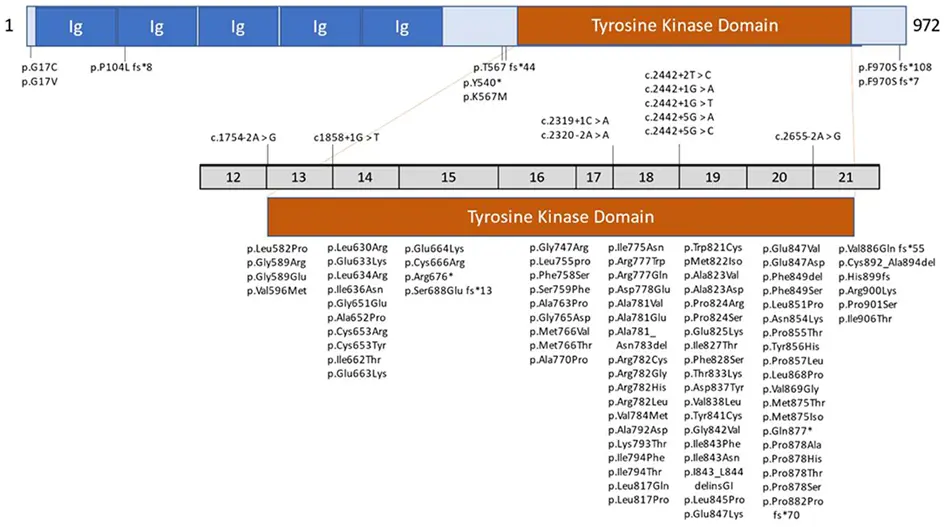
Figure 1. Schematic graph of the CSF1R protein and overview of CSF1Rmutations identified in patients with CSF1R-related leukoencephalopathy. CSF1R, colony-stimulating factor 1 receptor; Ig, immunoglobulin domain.[1]
[1] Papapetropoulos S, Pontius A, Finger E, et al. Adult-Onset Leukoencephalopathy With Axonal Spheroids and Pigmented Glia: Review of Clinical Manifestations as Foundations for Therapeutic Development. Front Neurol. 2022;12:788168.
Suspected pathophysiologic mechanism
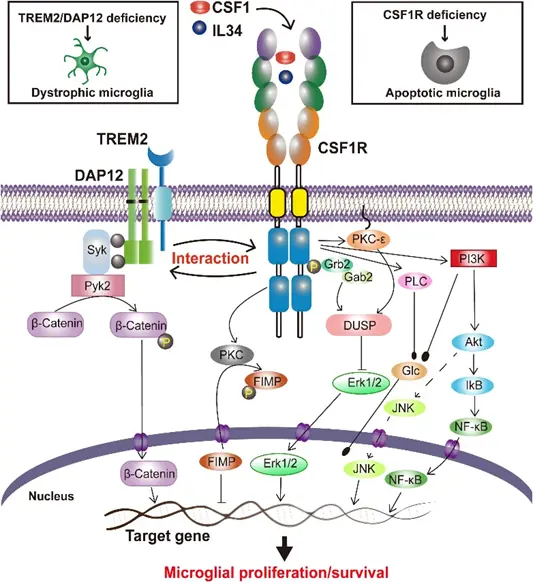
The pathogenesis of ALSP primarily arises from defects in the CSF1R and TREM2/DAP12 signaling pathways. Mutations in CSF1Rlead to microglial apoptosis, while deficiencies in TREM2/DAP12 result in microglial degeneration. Under normal conditions, CSF1R activates downstream signaling pathways such as PI3K, PLC, and NF-κB to maintain microglial survival and function. Meanwhile, the TREM2/DAP12 pathway regulates microglial proliferation and immune response through signaling molecules like Syk and Pyk2. When these pathways are disrupted, microglia fail to effectively clear damaged neurons, suppress neuroinflammation, and maintain brain homeostasis. This dysfunction of microglia leads to demyelination of white matter, axonal swelling, and neurodegenerative damage, accelerating the progression of ALSP and ultimately resulting in cognitive, motor, and psychiatric deterioration.
Figure 2. Proposed CSF1R-mediated signaling in microglial survival and proliferation. Stimulated by the ligands, CSF1 or IL34, CSF1Rs are undergoing a rapid dimerization, a self-tyrosine phosphorylation, and activation of PI3K/Akt, JNK, and ERK1/2 pathways, regulating microglia proliferation and survival. CSF1R also interacts with TREM2/DAP12, mediating microglial survival. [2]
[2] Hu B, Duan S, Wang Z, et al. Insights Into the Role of CSF1Rin the Central Nervous System and Neurological Disorders. Front Aging Neurosci. 2021;13:789834.
Diagnostic testing
• Genetic Testing:
a) CSF1RGene Mutation:
The primary diagnostic test for ALSP is genetic testing for mutations in the CSF1Rgene by whole exome sequencing.
b) RNA Sequencing:
If CSF1Rmutations are not found by whole exome sequencing, RNA sequencing may help identify splicing variants in the intronic regions.
• Neuroimaging:
a) MRI: Common findings include bilateral white matter lesions, brain atrophy, and thinning of the corpus callosum.
b) CT: Calcifications in periventricular regions may be present in some cases.
• Clinical Evaluation:
A thorough review of symptoms, including cognitive impairment, motor dysfunction, and neuropsychiatric changes, is crucial for suspicion of ALSP.