DGKEnephropathy is an ultra-rare autosomal recessive kidney disorder caused by biallelic pathogenic variants in DGKE. The disease spectrum includes early-onset aHUS/TMA, chronic proteinuric nephropathy, and MPGN-like glomerular disease.
Most patients with DGKE-HUS present in the first year of life, often with microangiopathic hemolytic anemia, thrombocytopenia, acute kidney injury, hypertension, hematuria, and nephrotic-range proteinuria. Chronic proteinuria, persistent hypertension, and progression to chronic kidney disease are common long-term features. Unlike complement-mediated aHUS, DGKEnephropathy is considered a complement-independent TMA, although secondary complement activation may occur in some cases.
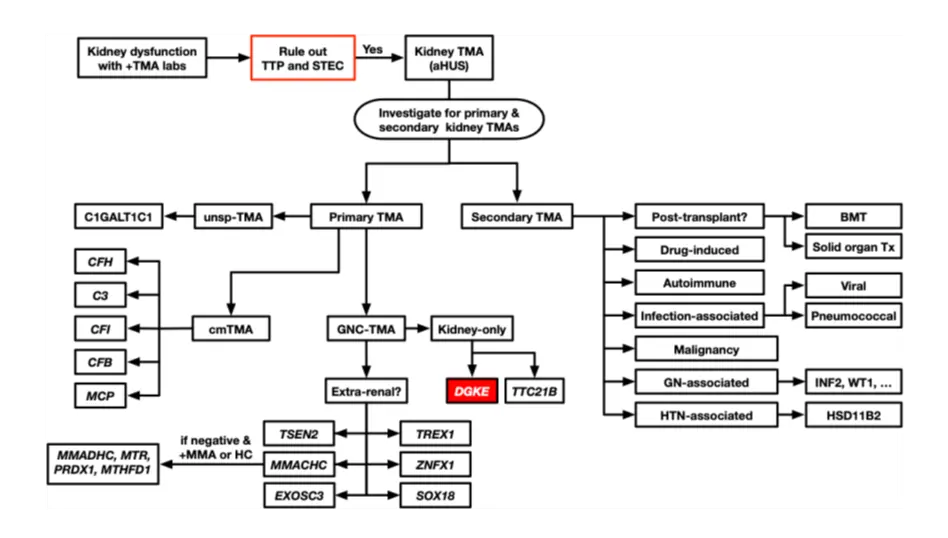
Figure 2. Diagnostic algorithm for kidney thrombotic microangiopathy (TMA), tracing the path to a DGKE-nephropathy diagnosis.
Kidney dysfunction with laboratory evidence of TMA first requires exclusion of TTP and STEC-HUS (red box). Once these are ruled out, the presentation is designated kidney TMA (aHUS) and investigated in parallel for primary and secondary causes. Primary TMA is partitioned into three genetic categories: complement-mediated TMA (cmTMA), unspecified TMA (unsp-TMA), and genetic non-complement TMA (GNC-TMA). The GNC-TMA arm is further resolved by the presence or absence of extra-renal features. DGKE(red) is the prototypical non-syndromic, kidney-limited GNC-TMA gene and the diagnostic endpoint highlighted by this algorithm. Secondary TMA is considered once a primary TMA is ruled out, and includes post-transplant disease, drug-induced, autoimmune, infection-associated, malignancy-associated, glomerulopathy-associated, and hypertension-associated forms.
Process abbreviations:TMA, thrombotic microangiopathy; aHUS, atypical hemolytic uremic syndrome; TTP, thrombotic thrombocytopenic purpura; STEC, Shiga toxin–producing Escherichia coli; GN, glomerulonephritis; HTN, hypertension; Tx, transplant; BMT, bone-marrow transplant; MMA, methylmalonic acidemia; HC, homocystinuria.
Gene symbols:CFH, complement factor H; CFI, complement factor I; CFB, complement factor B; MCP, membrane cofactor protein (CD46); C3, complement component 3; C1GALT1C1, C1GALT1-specific chaperone 1 (Cosmc); DGKE, diacylglycerol kinase epsilon; MMACHC, metabolism of cobalamin associated C (cblC); MMADHC, metabolism of cobalamin associated D (cblD); MTR, 5-methyltetrahydrofolate–homocysteine methyltransferase (methionine synthase); PRDX1, peroxiredoxin 1; MTHFD1, methylenetetrahydrofolate dehydrogenase/cyclohydrolase/formyltetrahydrofolate synthetase 1; TSEN2, tRNA splicing endonuclease subunit 2; EXOSC3, exosome component 3; TREX1, three-prime repair exonuclease 1; ZNFX1, zinc finger NFX1-type containing 1; SOX18, SRY-box transcription factor 18; TTC21B, tetratricopeptide repeat domain 21B; INF2, inverted formin 2; WT1, WT1 transcription factor; HSD11B2, hydroxysteroid 11-β dehydrogenase 2.