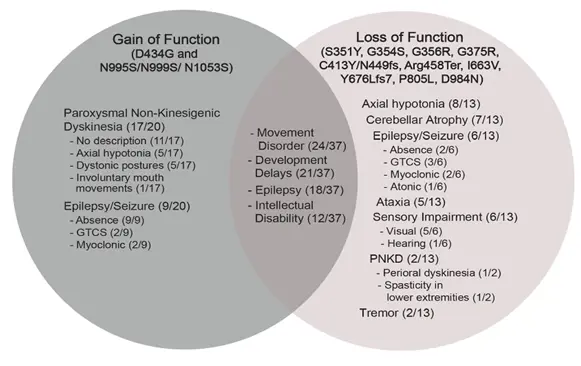
Epilepsy/Seizure Disorders
Miller et al. reported approximately 50% of patients with a KCNMA1 channelopathy experience epilepsy/seizure disorder phenotypes. Both Bailey et al. (2019) and Miller et al. (2021) reported heterogeneity of seizure/epileptic disorder phenotypes across allelic variants. These seizure phenotypes included absence, atonic, myoclonic, generalized tonic-clonic and one report of epileptic encephalopathy. (Bailey et al. (2019); Miller et al. (2021)).
Terms previously documented in patient diagnoses include:
• Unspecified epilepsy/seizures
• Atonic seizures
• Generalized tonic seizures
• Epileptic encephalopathy
• Generalized tonic-clonic
• Infantile spasms
• Myoclonic epilepsy/seizures
• Temporal lobe epilepsy
• Complex partial absence seizures
• Dystonic seizures
• Absence seizures
• Status epilepticus
Movement Disorders
Miller et al. reported approximately 85% of patients with a KCNMA1 channelopathy experience movement disorder phenotypes. Several types of movement disorders have been associated with KCNMA1 variants. Patients carrying Loss-Of-Function variants may display a variety of phenotypes across all types of allelic variants including myoclonus, apraxia, ataxia, spasticity, tremors, parkinsonism and chorea. While not mutually exclusive, patients carrying Gain-Of-Function variants, specifically the D434G and N999S (rs886039469; also reported as N995S, N1036S, and N1053S with different reference sequences) variants, more homogenously display paroxysmal nonkinesigenic dyskinesia-3 with or without generalized epilepsy (PNKD3). PNKD3 is the most reported symptom of KCNMA1-linked channelopathy and is described as a sudden onset “drop attack” or behavioral arrest with temporary atonic loss of postural muscle control. These episodes are characterized by brief variable episodes of dystonia, hypotonia or non-narcoleptic cataplexy and typically begin in patients before 24 months (Park et al. (2022)). The episodes are high frequency (hundreds a day) and stimulant responsive (Keros et al. (2022)).
Terms previously documented in patient diagnoses include:
• Myoclonus
• Axial hypotonia
• Ataxia
• Dystonia
• Apraxia
• Areflexia
• Perioral dyskinesias
• PKND
• Spasticity
• Unspecified paroxysmal dyskinesia
• Tremor
• Drop attacks
• Weakness
• Chorea
• Paroxysmal kinesigenic dyskinesia
• Myoclonus
• Parkinsonism
• Hypotonia
Neurodevelopmental Abnormalities
Miller et al. reported approximately 70% of patients with a KCNMA1 channelopathy may experience neurodevelopmental phenotypes including autism spectrum disorder, attention deficit disorder, intellectual delays and developmental disabilities. There have also been several reports of conduct and behavioral disorder, nonspecific, motor delay and learning disabilities. The origin of neurodevelopmental abnormalities associated with KCNMA1-linked channelopathies cannot be definitively linked to gene variant or secondary to epileptic/seizure disorder phenotypes with the currently available data. It remains to be determined if there is a higher incidence of atypical neurocognitive phenotypes in Loss-Of-Function patients versus Gain-Of-Function patients.
Terms previously documented in patient diagnoses include:
• Autism spectrum disorder
• Behavioral/conduct disorder
• Speech delay
• Dysarthria
• Intellectual disability
• Developmental/cognitive delay
• Learning disability
• Delayed development milestones
Structural Malformations
Miller et al. reported approximately 30% of patients with a KCNMA1 channelopathy experience structural malformation phenotypes. Patients with both Gain-Of-Function and Loss-Of-Function variants displayed structural CNS abnormalities with the most reported being cerebellar atrophy. In some cases, this atrophy has been described as progressive with subsequent widespread cortical atrophy. In addition to brain malformations, a subset of KCNMA1 variants have been classified as ‘Liang-Wang syndrome,’ described as a heterogeneous polymalformation syndrome manifesting at birth. All patients are reported to have some degree of neurologic dysfunction. Severely affected individuals show developmental delay, impaired intellectual development, poor or absent speech, marked craniofacial dysmorphisms, and visceral and connective tissue abnormalities affecting the bones and vessels (Liang et al. (2019)).
Terms previously documented in patient diagnoses include:
• White matter disease/ abnormalities
• Cerebellar atrophy
• Cerebral atrophy
• Cortical atrophy
• Hypoxic encephalopathy
• Nystagmus
• Microcephaly
• Hypoplasia
Figure from Bailey et al. (2019).