
The KCNMA1 gene is located on human chromosome 10q22. KCNMA1 encodes for ‘BK’ K+ channel, the large conductance voltage- and Ca2+-activated K+ channel. The BK channels of neuronal and muscle tissues respond to changes in intracellular Ca2+ and depolarization, allowing K+ to exit the cell and hyperpolarize the membrane. Mutations in KCNMA1 that alter BK channel gating have been associated with hyperexcitability in the hippocampus and lowered seizure thresholds, and PNKD in mouse models.
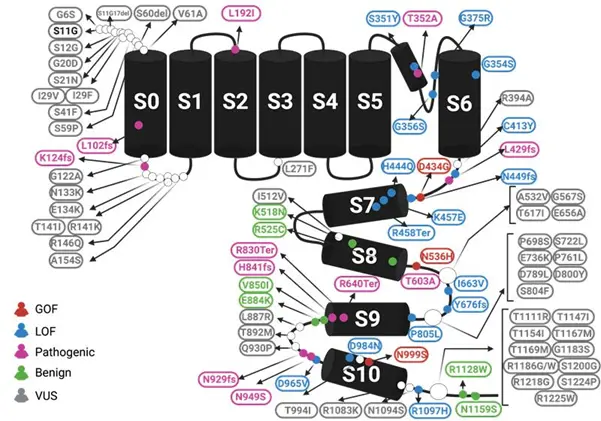
The mechanism of KCNMA1-linked channelopathy symptoms is not yet well-defined but is likely similar to that of other known channelopathies. The BK channel contributes to both neuronal and muscular activity; therefore alterations in the channel function are suspected to be the pathophysiologic mechanism of patient phenotypes. In the brain, there are likely changes in the balance of neuronal excitability and inhibition, leading to dyskinesia and seizure phenotypes. Increased neuronal firing has been demonstrated for two patient variants in mouse models.
Mutations in KCNMA1 are rare and commonly occur de novo with an autosomal dominant inheritance pattern or apparent autosomal dominant effects. Fewer than three cases have reported autosomal recessive inheritance patterns. KCNMA1-linked channelopathy variants include single nucleotide mutations, frameshift deletions and nonsense variants in the KCNMA1 gene encoding the BK K+ channel. Some intronic variants are also known.
With respect to functional classifications based on BK channel activity, as of 2022, there are currently 3 confirmed gain-of-function variant types, 17 confirmed and putative loss-of-function, 11 pathogenic (computational prediction), and 45 VUS or putative benign. The number of KCNMA1 variants is likely to increase over the next several years as patient data identification improves. Currently, there are 64 gene panels that include KCNMA1 variants (NIH Genetic Testing Registry). Functional classifications are presently based on variant effects on BK channel activity, but should be formally assessed in the context of a model representing the patient genotype zygosity.