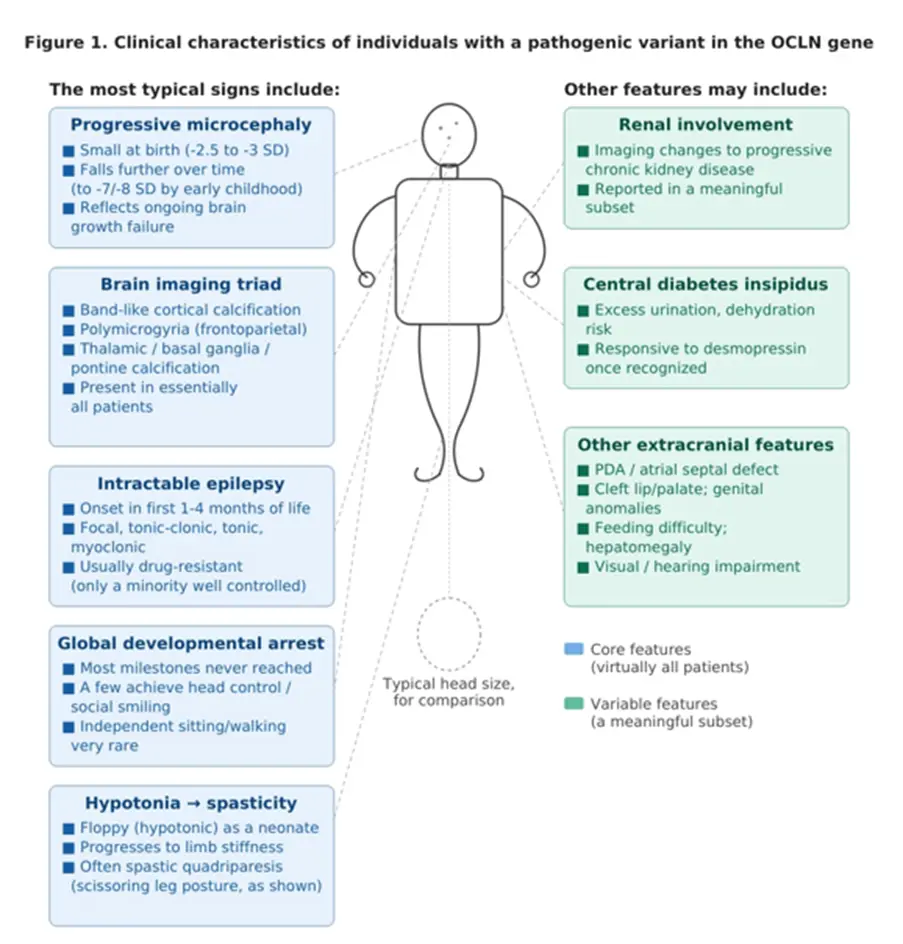
Pathogenic variants in the OCLNgene cause a multisystem disorder dominated by severe brain involvement (Figure 1).
Features present in almost all individuals with an OCLNmutation:
• Progressive microcephaly
o Often already reduced at birth (typically −2.5 to −3.2 SD), falling further over time, sometimes to −7 or −8 SD
o Reflects ongoing failure of brain growth rather than a single static insult
• Early-onset, intractable epilepsy
o Onset typically within the first 1–4 months of life
o Mixed seizure types: focal, generalized tonic-clonic, tonic, myoclonic
o Usually drug-resistant; only a minority achieve good control
• Global developmental arrest
o Most patients fail to acquire any developmental milestones
o A minority achieve limited skills (head control, social smiling, visual tracking)
• Hypotonia evolving into spasticity
o Generalized hypotonia in the neonatal period, progressing to spasticity / spastic quadriparesis
• Characteristic neuroimaging triad: band-like calcification, simplified gyration, and polymicrogyria
o Symmetrical band of calcification in deep cortical gray matter
o Additional calcification in thalami, basal ganglia, pons, and cerebellum (in ~2/3 of patients)
o Bilateral, symmetrical polymicrogyria, predominantly frontoparietal
o Reduced white matter volume, thin corpus callosum, ventricular dilatation
Features present in a meaningful subset of patients:
• Renal involvement: from isolated imaging findings to progressive chronic kidney disease; has contributed to mortality in some patients. One Turkish frameshift variant has been particularly associated with renal failure.
• Central diabetes insipidus:reported in at least two patients; responsive to desmopressin when recognized
• Other extracranial anomalies: patent ductus arteriosus, atrial septal defect, cleft palate/lip, imperforate anus and genital anomalies, hepatomegaly
• Feeding difficulties: related to hypotonia/spasticity and oromotor dysfunction
• Visual and auditory impairment
Penetrance
Penetrance for the core neurological phenotype appears complete in reported patients. There is real variability in extracranial involvement, particularly renal disease and diabetes insipidus, not yet reliably predictable from genotype.
Prognosis
The prognosis is generally poor. Most patients never acquire independent mobility, speech, or self-care skills. Mortality has been reported in early-to-mid childhood, often related to intractable seizures, respiratory complications, sepsis, or progressive renal failure.
Figure 1: Clinical characteristics of individuals with a pathogenic variant in the OCLNgene