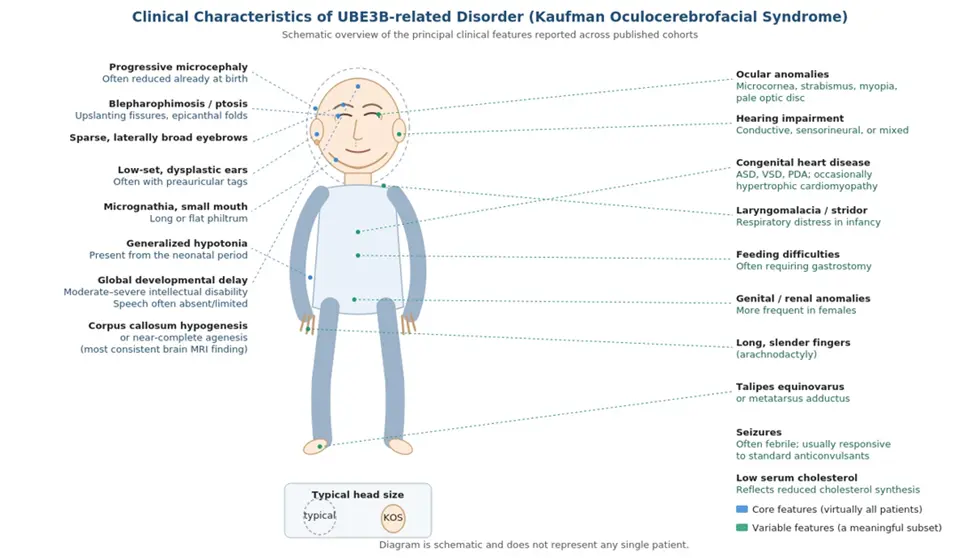
Pathogenic variants in the UBE3Bgene cause a multisystem disorder dominated by a distinctive craniofacial appearance, growth failure, and neurodevelopmental impairment (Figure 1).
Features present in almost all individuals with a UBE3Bmutation:
Distinctive craniofacial gestalt
• Blepharophimosis (short, narrow palpebral fissures) with or without ptosis
• Upslanting palpebral fissures, epicanthal folds, telecanthus or hypertelorism
• Sparse, arched, laterally broad eyebrows
• Micro- or retrognathia, small mouth, thin upper lip; long or flat philtrum
• Low-set, cupped, or dysplastic ears, frequently with preauricular skin tags and stenotic external auditory canals
Progressive microcephaly
• Often already reduced at birth, with frontal bossing and a long, narrowing face that becomes more pronounced with age
Generalized hypotonia
• Present from the neonatal period in almost all patients
Global developmental delay and intellectual disability
• Typically, moderate to severe; expressive speech is frequently absent or severely limited, although receptive skills and sociability are often relatively preserved
Characteristic neuroimaging finding: corpus callosum hypogenesis/agenesis
• Hypogenesis or near-complete agenesis of the corpus callosum is the most consistent structural brain finding
• Dilated ventricles, Chiari type 1 malformation, and pituitary anomalies have also been described
Features present in a meaningful subset of patients:
Ophthalmologic anomalies: microcornea, strabismus, myopia/astigmatism, pale optic discs and, less commonly, iris coloboma or microphthalmia.
Hearing impairment: conductive, sensorineural, or mixed; common and should be actively screened for.
Cardiac anomalies: atrial and ventricular septal defects, patent ductus arteriosus, aortic coarctation, and, in a subset, hypertrophic cardiomyopathy with outflow tract obstruction.
Respiratory problems:laryngomalacia, tracheomalacia, or stridor are frequent in infancy; severe cases have required tracheostomy.
Feeding difficulties: nearly universal in infancy, often due to poor suck, gastroesophageal reflux, or pylorospasm; frequently require gastrostomy tube placement.
Seizures:often febrile in onset; usually manageable with standard anticonvulsants such as valproate or levetiracetam.
Genitourinary anomalies:genital differences are relatively common, particularly in females (hypoplastic labia, clitoromegaly); renal anomalies (small kidneys, duplicated renal pelvis, vesicoureteral reflux) occur in a minority.
Skeletal anomalies:long, slender, tapering fingers (arachnodactyly); talipes equinovarus or metatarsus adductus.
Low serum cholesterol:documented in roughly half of tested patients, thought to reflect downregulated cholesterol synthesis.
Frequency of clinical features (combined published cohort, n=33)
The table below combines the nine newly reported Egyptian patients (Zaki et al., 2020) with the 24 previously published, molecularly confirmed patients, giving the most complete frequency estimate currently available for this disorder:
• Blepharophimosis: 33/33 (100%)
• Epicanthal folds: 33/33 (100%)
• Developmental disability/intellectual disability: 32/32 (100%)
• Hypotonia: 32/33 (97%)
• Arched/sparse laterally broad eyebrows: 32/33 (97%)
• Anteverted nares/short nose: 30/33 (91%)
• Absent/delayed speech: 20/22 (91%)
• Feeding difficulty: 29/30 (88%)
• Microcephaly: 27/32 (84%)
• Micro/retrognathia: 23/32 (72%)
• Ptosis: 20/29 (69%)
• Small mouth: 22/33 (67%)
• Thin upper lip: 22/33 (67%)
• Abnormal brain imaging: 19/26 (73%)
• Hearing impairment: 18/30 (60%)
• Low cholesterol levels: 15/25 (60%)
• Low birth weight: 15/30 (50%)
• Long face: 17/24 (71%)
• Sparse scalp hair: 14/33 (42%)
• Congenital heart disease: 11/33 (33%)
• Respiratory distress: 13/33 (39%)
• Genital anomalies: 13/33 (39%)
• Dysplastic ears: 10/33 (30%)
• Cleft palate: 9/33 (27%)
• Microcornea/microphthalmia: 9/33 (27%)
• Pes talus varus/valgus: 9/33 (27%)
• Seizures: 9/33 (27%)
• Renal anomalies: 8/33 (24%)
• Nail dysplasia: 5/33 (15%)
Note: consanguinity was documented in 17/25 families (68%) across this combined cohort.
Rarer findings of diagnostic interest
A small number of findings have only been reported in one or two patients each, but may be useful diagnostic clues when present alongside the core phenotype:
• Spherophakia(an abnormally spherical lens) – reported for the first time in KOS by Zaki et al. (2020); not previously described in any patient with this condition
• Hypoplastic or absent distal phalanges with nail dysplasia: described in patients reported by Kariminejad et al. (2017), Galarreta et al. (2019), and Zaki et al. (2020); infrequent but considered a valuable diagnostic clue when present
• Hypertrophic cardiomyopathy with subaortic or subvalvular stenosis: reported in two siblings by Zaki et al. (2020) and in one patient by Yilmaz et al. (2018); raises the question of whether a second, independent genetic contributor might be present in affected sibling pairs from consanguineous families
• Prominent or full cheeks in younger patients (“middle-third-of-face prominence”): highlighted by Yilmaz et al. (2018) as an underrecognized feature, visible in roughly half of published cases with adequate photographs, more apparent at a younger age
• Torticollis of muscular origin: noted in several patients and attributed to hypotonia and reduced neck muscle mass rather than a skeletal cause
• Intestinal malrotation:reported incidentally (i.e. without symptoms) in two patients by Galarreta et al. (2019), and symptomatically in one patient by Basel-Vanagaite et al. (2012)
Penetrance
Penetrance for the core craniofacial and neurodevelopmental phenotype appears complete in reported patients. There is real variability in extracranial involvement (particularly cardiac, renal, and ophthalmologic findings), not yet reliably predictable from genotype.
Prognosis
Most patients have moderate-to-severe lifelong intellectual disability with little or no expressive language. Growth and feeding difficulties tend to improve with supportive management, and several patients have now been followed into the second and third decade of life with stable, if limited, function. The overall prognosis is most strongly influenced by the severity of associated cardiac, respiratory, and neurological complications rather than by the craniofacial features themselves.
[Figure 1:Clinical characteristics of individuals with a pathogenic variant in the UBE3Bgene]